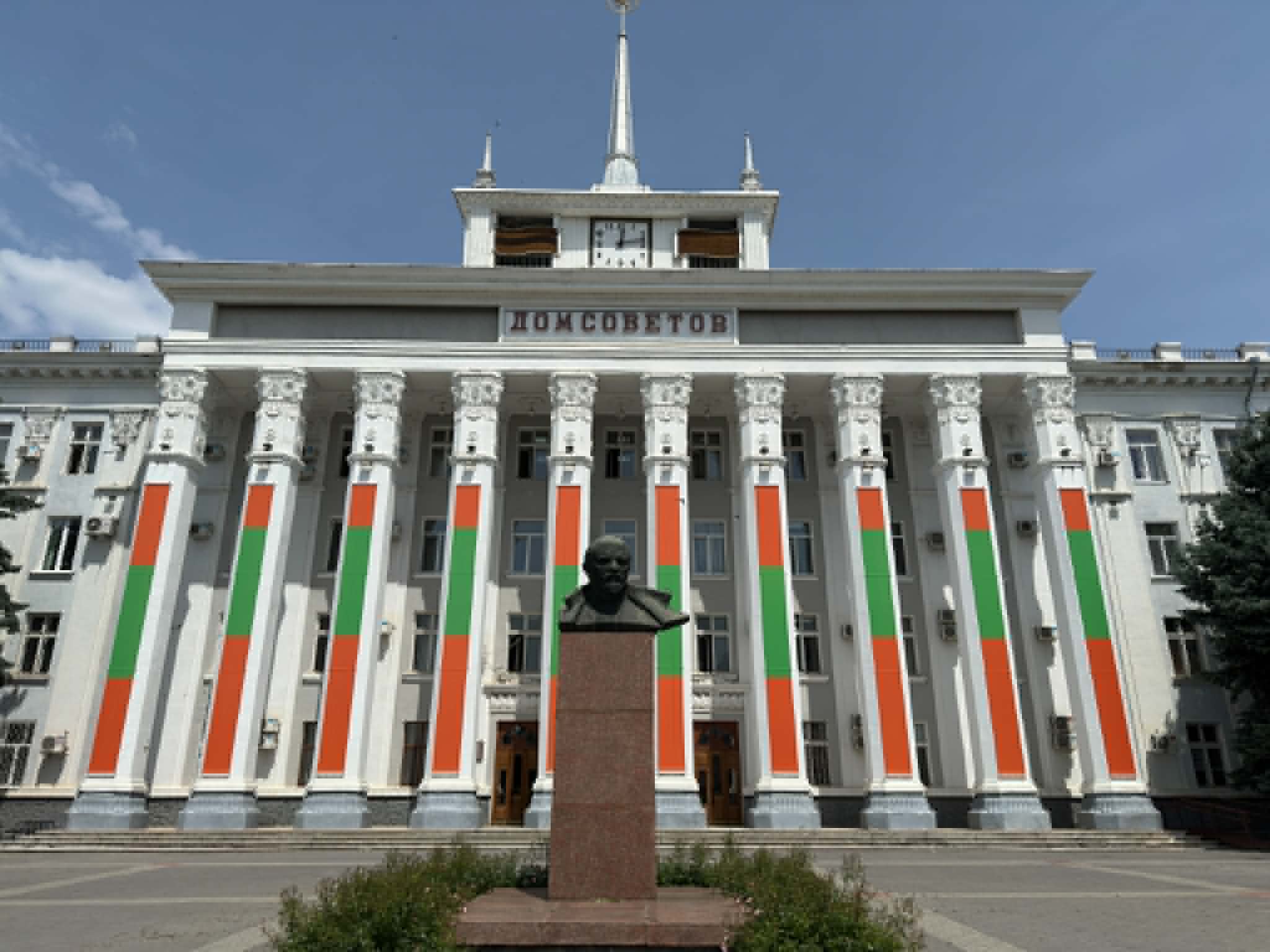
The PMR (Pridnestrovian Moldavian Republic, or Transnistria as some call it) is a small unrecognized breakaway state sandwiched between Moldova and Ukraine. No UN member recognizes it as an independent country, it is not in any international organization, and yet it has its own government, army, currency and passport. It has been on my radar for a while. Partly because it is the kind of place that might simply stop existing in the near future. It sits between Moldova, which rightfully wants to reintegrate it, and Ukraine, which views the Russian military presence there as a potential threat. PMR’s situation reminded me of Nagorno-Karabakh (Artsakh), another unrecognized region, this time populated with Armenians, which however disappeared almost overnight after Azerbaijan’s 2023 offensive. Artsakh was one of only three entities that officially recognized the PMR, the other two being South Ossetia and Abkhazia. Their flags used to stand together in Tiraspol’s central square. Today Artsakh’s flag is gone.
But beyond the geopolitics, I also just wanted to see something different. I am not particularly into Soviet nostalgia, but I am into places that feel genuinely unlike everywhere else. Right now in Europe everything looks the same. It does not matter if you are in Oslo or Sofia, you will find the same Irish pub, the same Italian coffee place, the same ads in English. So I wanted something authentic, I guess…
We started in Chisinau, the capital of Moldova – officially the poorest country in Europe. We drove there and the roads were somehow even worse than Bulgaria. The city did not leave much of an impression in the short time we had. What did catch me off guard was that almost everything was in Russian. Signs, conversations, shops. Romanian was there too but English was rare. Moldova was part of the Soviet Union so it makes sense. Most Moldovans consider themselves Romanians and Romania considers Moldova part of it (reminds of Bulgaria and North Macedonia, minus the drama). Chinisau, however, did not feel Moldovan at all. Most of the people we encountered spoke either Russian or Ukrainian and physically seemed different from Moldovans (risking to sound racist here lol).
The next day we drove to Tiraspol, about an hour away. One military checkpoint, one border crossing. A soldier reloaded his machine gun right in front of me and I will admit I was not entirely calm about that. But the border guards were genuinely friendly and helpful with the paperwork. There were stray dogs sleeping at the checkpoint. Very calm overall.
We entered through the industrial outskirts, which looked like any other Eastern European place. Then the city announced itself: large billboards, hammer and sickle symbols, Sheriff signs everywhere. Sheriff is basically the economic engine of the PMR: supermarkets, petrol stations, the football club and its enormous stadium. The Sheriff oligarch at the top is considered close to the Kremlin.
We parked near the central Lenin statue and explored on foot. Monuments for Pridnestrovians who died in World War Two, in the 1992 war of independence, in Afghanistan, and for those who responded to Chernobyl (liquidators). Next to them a T-34 tank and a church. A garden with more monuments including one to Catherine the Great, who founded Tiraspol. We also found the Pridnestrovian Harry Potter, a monument that does genuinely look a bit like him, officially, however they deny any resemblance 😂.
The city surprised me. It is not stuck in the past the way some travel accounts make it out to be. The Soviet monuments are everywhere yes, but people drive Teslas (I counted 14), use the latest iPhones, and do not seem particularly “communist” in daily life. Modern cafes sit next to panel apartment blocks, just like in Bulgaria. Young people were out celebrating their last day of school, dressed in white shirts and black trousers.
Worth knowing: they have their own currency, the Pridnestrovian ruble, which you can only get and use there. Western cards do not work. No mobile signal for us either. Wi-fi was available and people were helpful.
On the way back we stopped in Parcani, the largest Bulgarian-majority village outside Bulgaria itself, sitting between Tiraspol and Bender. About 95% of its roughly 10,500 residents are ethnic Bulgarians, descendants of settlers who arrived in the early 19th century. There is a monument to Vasil Levski in the village square. Quiet and a bit empty when we passed through, but a genuinely wholesome thing to stumble upon in the middle of Pridnestrovie.
Then the city of Bender. More military checkpoints, a Russian peacekeeping contingent is stationed there. We only had time for the Ottoman Bender Fortress, well preserved, complete with cannons and a torture room, very cheap to enter and worth it.
Then we did not realize we had crossed out of Pridnestrovie until signs in Romanian started appearing alongside EU flags. The city of Bender is split: part is controlled by the PMR, the adjacent commune of Varnița is under Moldovan government control. The transition is invisible until suddenly it is not.
There is plenty more to see in Tiraspol, Bender and other parts of the PMR. There is more to see in Moldova itself, for sure. But, overall, we were happy with the short trip.
Leave a comment